Wednesday, October 5, 2022

Insecure Wednesday: After 7 Years, I Can Definitively Say Reader Magnets Only Partially Works

Over seven years ago in August of 2015 I read this Reader Magnets book and decided I would apply its lessons--or as many as I could.  I made a website, I put some books for free, I created a newsletter, and to get people to sign up for the newsletter I held back a book I'd written to give to people.

And the results were...meh.  The one thing that does work is making the first book of your series free.  I got a ton of sales for the other two Chances Are books when the first one became free.  I still get people buying the other two books occasionally even though they've been out for 9 years.  It works less often for some of the Eric Filler ones but I do sometimes still get people buying the other two books in the Gender Swap Challenge series.

I think the caveat is that it works better for a series that's a continuous series and not an anthology series.  For a series like the original Transformed series by Eric Filler, where each book was a different thing, making the first six books free didn't mean people would buy the other books as much--though some still do.  Whereas with Chances Are or Gender Swap Challenge that have a recurring character, people are more inclined to buy the other books to read how the story continues.

Making a free book for newsletter subscribers does work--somewhat.  It does get people to sign up for your newsletter.  It does not necessarily get them to do anything with your newsletter.  There were a few times when someone would sign up for the newsletter and then quit once they got the free book, though not as often as a cynical person like me would think.  

The average open rate for my newsletter is about 35%.  And that's actually really good by industry standards.  The average click rate though is only about 15%.  Put it this way:  if I have 440 subscribers and 15% click a link, then that means 66 people clicked something.

And that's just clicking anything.  It could be my book or (more often) it was the free book by someone else I'd put in there.  Or it could be a link to Goodreads or Amazon or something else, though again that was less likely.

A couple months ago I got tired of putting free books in and just put my book in.  The click rate dropped from about 15% to about 5%.  So of 440 people, maybe 22 would actually click on the page for my book.  How many would actually buy it then?  That's harder to say.

What definitely did not work was this whole putting a free book in the newsletter thing.  The idea in Reader Magnets is you put this free book in and people think you're a great guy and so they want to buy your books.  Basically it's like Miracle on 34th Street where Santa tells people where to get a better deal than Macy's and so people decide to buy stuff from Macy's out of gratitude.  I can tell you that this idea is bullshit.  At least with my readers.  

Instead what happens is you get people who just sign up for free books.  Most of the unsubscribes when I drill down into their history, if they clicked anything it was just free books.  So it's most likely those people didn't do anything for me.  Instead of shopping at Macy's, the people in real life would have kept shopping at other stores and going back to Santa to ask for more deals and then get pissed if he stopped telling them.

This still works best by the junk mail philosophy:  if you get lots and lots and lots of subscribers then even if only 5% click anything, that will be a lot of clicks.  Even with free books (I've had at least 4 different ones in the last 7 years) and putting an ad in my books, I still don't get the thousands of subscribers I would really need for this to be extremely successful.  Because it is just a numbers game.  Like I said, it's the junk mail philosophy that the vast majority of people will throw it away, but if a few buy the product or service, then you make up for the cost of the mail.  I don't know if I really sell enough books from the newsletter to pay for the website; it's hard to say since people buy the books from Amazon and not directly from me.  It would probably work better if I were writing in a more mainstream genre, though then you still have the problem of getting people to notice you to sign up for the newsletter and all that.

Anyway, as I said, it was partially successful, so that's not nothing.  But like most of these things, it's probably not going to make you rich and famous overnight.

Monday, October 3, 2022

Don't Trivialize Your Ending

Long, long ago in 1998 or so I briefly wrote some columns for a little local sci-fi magazine.  Not because anyone wanted me to but since I was working on the website I figured I should get something for my trouble; a column no one would care about was basically my compensation.  In one of my columns, I complained about the end of an episode of Star Trek Voyager.  

Looking back, I guess it was the finale of the 4th season--whatever that was.  Some bad shit happened and people had died or something and I complained it was inappropriate at the end for Janeway to be playing racquetball or whatever with 7 of 9 instead of contemplating what had happened. A great dramatic character moment had been lost!  Here's what I actually said, fished out of my archives on my backup hard drive:

Watching the season finale made me lose all respect for the show’s most pivotal character (or what is supposed to be the most pivotal character), Captain Janeway. It was Janeway’s reckless alliance with the Borg that destroyed the alien’s home, and yet she didn’t even care. She gave a token apology, which didn’t even seem like she meant it, and moved on. Her whole attitude suggested that the alien should just get over almost his entire race being wiped off the face of the galaxy, because she in her infinite wisdom had made a selfish decision to benefit her crew alone. I’m sorry, but you don’t just shrug off inadvertently killing billions of people, especially not if you’re a Federation captain. Life is sacred, and a captain showing so much disrespect made me angry. I actually wanted Janeway to be assimilated by the Borg. I can’t ever remember pulling so hard for a "villain" before, but to me, the real villain wasn’t the alien seeking revenge for the deaths of his race, but the Federation captain who showed no remorse

If you ask me…and few people do, I would have ended the season finale with some kind of human element. Instead of having Janeway and Seven playing some silly game on the holodeck, I would have rather seen Janeway in her quarters having some kind of reaction about what she had done. Even if she couldn’t have known, she should have felt guilty in some way. When you know a decision you made has cost innocent people their lives, you have to feel responsible, command training or no. 

Fast-forward to 2022 and I had the same feeling watching an episode of The Orville.  The episode was largely a ripoff of Star Trek IV as the dumbass pilot gets lost back in 2015 and the crew has to save him, but they can only go back to 2025, by which time he has a wife and kids and a good life--that they erase by going back to 2015 to "save" him before he met anyone.

The way the end of the episode plays out, the dumbass pilot is talking to the captain and first officer and it's really weird then how he's comforting them.  He's saying stuff like, "That must have been such a hard decision for you."  And then they get out a bottle of booze to drink the night away.

And like before, I thought a great dramatic character moment had been lost!  Instead of comforting the people who cost him happiness and getting drunk, the dumbass should have been in his quarters, holding the phone from 2015, and thinking of what might have been.  Then they could have him decide to quit and start a family--that's just my wishful thinking.

If you're wondering, it's not just me who thinks this way.  Reading Harlan Ellison's original version of City on the Edge of Forever, he commented how he really didn't like how Roddenberry/Shatner/whoever else changed the ending.  In his original ending, Kirk is in his quarters after having lost Edith Keeler in the past.  Spock goes in and comforts him and even calls him Jim.  A great dramatic character moment!

But the ending that aired has Kirk going on the bridge and saying tersely, "Let's get the hell out of here."  There are a number of reasons this might have been done:  time or maybe Shatner thought the end was too wimpy for Kirk or whatever else.  But the original was a better ending because it let our characters be vulnerable and feel something.  Just going up to the bridge and saying, "Let's get the hell out of here," or playing racquetball, or getting drunk trivializes what happened.  You might as well have them shrug and say, "Whatever."

I get these are largely episodic TV shows, so it's not really supposed to be all dramatic and have a lot of character changes and stuff.  Still, just letting a little humanity in is nice for me, the viewer.  Because if your character is trivializing what just happened, then shouldn't I do that as well?

[Shrugs] Whatever.  Let's get the hell out of here to go play racquetball and then get drunk.

(Fun Fact:  Brannon Braga is/was a writer/producer on both Voyager and The Orville, so maybe I shouldn't be surprised they have the same bad storytelling.)

Friday, September 30, 2022

Even A Redeye Can Provide A Fresh Perspective

 It's a fact of life that with comedy you're not going to love every joke.  And as much as I love watching Rifftrax movies, there are some jokes I don't really like.  There are some jokes that are just downright wrong, like with Jack Frost they keep referring to the off-screen Uncle Henry talking to a very fake off-screen little girl at the beginning of the movie and they keep saying he's narrating the whole story when in fact his narration stopped by the end of the credits when Jack Frost was to be executed.  Or in Firehead they say the titular hero murdered a watchman when he blows up a bomb in a building, but we clearly see the watchman later in a TV interview, so obviously he didn't die.  There are other examples, though not too many.

Now we get to the opening of Oblivion, the 1994 sci-fi Western I actually don't hate and would probably watch without riffing if that were really possible.  In the first scene, the reptilian alien Redeye goes up to the Oblivion population sign where there's this weird chicken-monkey thing kind of like that weird little alien who was hanging out with Jabba in Return of the Jedi.  Redeye kills the chicken-monkey and uses its blood to change the population sign from 539 to 538.  Kevin Murphy blurts out, "That thing was counted?"  Because it seems like Redeye is changing the sign to subtract the weird chicken-monkey thing.

And, no, that's not true.  Aaaaactually it's because Redeye is going to murder the sheriff of Oblivion.  Hence decreasing the population by one.  Buuuuut, while the writer, director, and producers might all know that, there's no actual way for us, the audience, to know that until it happens.  Even then it probably took me fifteen viewings before the explanation hit me.

This is a problem writers can run into.  We are so close to the story because we wrote it, so we know what's going to happen.  If I wrote a scene like with the sign, I'd know Redeye is changing it because he's going to kill the sheriff, not because he killed the chicken-monkey.  But a reader who doesn't know what's going on would not know that.  He/she might actually think Redeye was subtracting the chicken-monkey.

And that's another example of why it's good to get beta readers to check out your story beforehand.  A fresh set of eyes, especially eyes that haven't seen the story before, might help point out things that don't make sense to them even though they make perfect sense to you.  It's also why companies have focus groups and have people test products, to find the flaws before they get to stores.

I thought of a couple of ways to fix the scene so it would make more sense:

  1. Take the chicken-monkey out and just have Redeye scratch the number out with a knife and then maybe say something like, "I'm coming for you, Marshal Stone."
  2. Again, take the chicken-monkey out and have Redeye blast the sign to pieces to show he's planning to really do some damage.
  3. Instead of a population sign, have a sign saying to re-elect Marshal Stone or a sign under the population sign saying, "Home of Marshal Stone" or something like that specifically mentioning the marshal and so when Redeye destroys it, we know who he's pissed at.

The third one I think gets the message across the best, while the other two still might be a little vague.  It's an example of how if you find a similar issue in your writing (or someone else brings it up) you can do just a slight change to make it clearer.

Wednesday, September 28, 2022

NonFiction Shows & The Value of a Hook

 A couple months ago the Movie House app added TV shows.  Like the movies, 99.9% of these you'd never have heard of.  Some I'm sure are from overseas and others just so small they're probably on local TV or YouTube or something.  But sometimes I like to put one on in the morning as I make breakfast and stuff.  I get 1-2% towards my total and some of the shows are kind of interesting.  The ones that are most interesting also have good hooks, which is something writers are always struggling with.

Painting the Town:  This is a pretty normal travel show where a dorky white guy goes to cities in the US and St. Thomas and talks to people, visits its main attractions, and eats at a restaurant or two.  The hook is the guy is an artist and as he goes to places he does sketches of the people and places to eventually make a painting.  The paintings are all kind of similar but it is a different spin on the travel show.  Amazon Prime Video listed three seasons from 2015-2018 but none are available there.  Here's the painting from the Baltimore episode.  I took it off a TV with my phone so it's not the best quality:


There's kind of an 8-bit original Nintendo feel about the painting.  They'd probably be good as jigsaw puzzles.  Anyway, it's still a neat way to do a travel show.

Evil Knows:  This is a show about science but it stars the bassist of the band the Bloodhound Gang.  He does a lot of Mythbusters-type stuff then to prove or disprove things.  There's stuff like getting punched by a boxer, pulling 7Gs in a Hawker Hunter aircraft, trying to elude a bloodhound, and going over 80 hours without sleep.  Interspersed there are segments on other "evil" things like the most dangerous city in the world (surprisingly not Detroit), the biggest fire truck, and an airport in Nepal (I think) where the runway is so short planes often crash.  Always one of the easiest and best hooks is involving a celebrity, even if it is a C-list celebrity.  And if that celebrity is getting punched or hunted by a dog it's even better!  If Keeping Up With the Kardashians had been Kim Kardashian being chased by a bloodhound, I'd have probably watched it.

Bad Jokes:  This features probably lesser celebrities in comedians, pro athletes, and YouTube "influencers."  It's a silly little show where a pair of comedians, athletes, or influencers try to make each other laugh by telling bad jokes taken off the Internet.  Like crappy "knock knock" jokes and so forth.  The influencers thing probably works better with younger generations than an old-timer like me.  The NFL episode featured future MVP Patrick Mahomes and a couple of now-former Detroit Lions.  They also had NBA players, NASCAR racers, and WWE wrestlers.  So that's a good way to get attention for your show.

Rock & Roll Road Trip:  Basically the concept of the show is rocker Sammy Hagar, known for hits like "I Can't Drive 55" and "Dreams," "When It's Love," Right Now," etc with Van Halen, travels to visit other 70s and 80s rockers like John Mellencamp and jam with them.  Hagar is not a great interviewer or anything, but if you like that classic 70s & 80s rock then it's cool to listen to him play with some other greats.  And as I said, having a celebrity is always a good hook.

Jam in the Van:  So some guys got an RV-type "van" that they converted into sort of a studio and invite bands to play in it.  Kind of neat idea.  The problem is they really need more of a framing device with the guys who started all of this and to get more views you'd need bands people might know.  It is cool to feature indie groups, but that's not going to make people tune in.  One episode did feature one of the guys interviewing the band, which really would have been good if they'd done that for every episode.  Another episode featured a band I'd actually listened to before:  Blues Traveler, who had a couple of hits in the mid-90s.  There were a couple of interview segments with lead singer John Popper and there was a duet with fellow 90s group The Spin Doctors on a reggae version of "Two Princes."  The music on the others was mostly Americana, reggae, and jazz, usually recorded at some kind of festival or event and usually there are a couple of different takes because you can see the performers wearing different clothes and stuff.  I did add a couple of the bands like Larkin Poe, Nickie Bluhm, Lukas Nelson, and the Wood Brothers to my Amazon wishlist to check out more of their stuff later.  So to some extent the show was successful for the people on it.

Mixtape:  I think this was a series by Spotify or something.  They talk to an artist and assemble a playlist of songs that inspired that artist, which also provides sort of a "Behind the Music" about that artist.  Most of the artists were older ones like Mickey Dolenz of the Monkees, Todd Rundgren, Don McLean, Rick Springfield, the guitarist of the Eagles, members of Foreigner, and lead singer of REO Speedwagon, but I suppose they still have fans, right?  I just wish they had interviewed some younger people or people in other genres because there's a lot of overlap in the "influences" part.  I mean when you pretty much only interview Boomers, of course they're going to mention Buddy Holly, Little Richard, Elvis, and the Beatles.  Everyone alive in the 50s and 60s was influenced by them!  So they really should have diversified a little.  I don't mean skin color as much as in age and genre.

Put Some Colour In Your Life:  This has a weaker hook but I suppose still somewhat of one.  It's about an Australian guy who rides around on a motorcycle and visits different artists in the country.  Then he talks to them about their art and inspirations.  Like I said, it's not as good but still somewhat of a hook to see some guy riding around on a motorcycle talking about art.

By contrast, here are a couple that don't have as much of a hook:

Beyond Your Backyard:  It's a pretty typical travel show where a schlubby white guy goes around to places in America (and Mexico and the Caribbean) to see the sights, talk to people, and eat the food.  There's not really much of a hook, but it is as interesting as most other travel shows.  Since I don't have money and now with Covid and all that can't really go places, I like travel shows to see what I'm missing.  Sometimes that's even places I've been like Chicago or the Mt. Rushmore area.

Food Stories:  This is really weird as it's basically this foreign guy with a strange accent very hurriedly giving an abbreviated history of several food items and providing some recipes.  They do 3-4 foods per episode, which really seems a bit much.  It ought to slow down and get someone who speaks English better instead of saying things like "Oh-ven."  But maybe that in itself is sort of a hook.

Ancient Grains:  This is pretty similar to the Food Stories one only it focuses on one grain per episode.  And the weirdly-accented narrator is female.  At one point she said "flerr" instead of "flour" and now I want to say it like that.  Besides different pronunciations for words, you might also learn about grains like corn, wheat, barley, or quinoa.  

Vegan:  This seems to be just YouTube videos of "influencers" making vegan stuff.  The videos are only about 5 minutes long and basically the quality you'd expect of something from YouTube.

The point here is if you want to attract people, it helps to have some kind of hook.  There are a ton of travel shows, so if you can do something a little different like have the guy hosting the show gathering material for a painting, then it makes it more interesting.  Similarly with books, there are tons of books about vampires or dystopias, so you should try to find something just a little different to get the attention of an agent or editor's minion going through the slush.

Of course the most reliable hook is having a celebrity involved.  Again, even if it's not a huge name, anyone even remotely famous will get more attention than a bunch of ordinary people.  That might be Evil but it's true.

Tuesday, September 27, 2022

The Expanse Short Stories Are More Hit Than Miss

Memory's Legion: The Complete Expanse Story CollectionMemory's Legion: The Complete Expanse Story Collection by James S.A. Corey
My rating: 4 of 5 stars

As with any short story collection, some are better than others.

  • Drive: It was OK but a little too short. 3/5
  • Butcher of Anderson Station: It was also OK but again maybe a little short. 3/5
  • The Churn: As someone who's read a lot of crime fiction in the last 11 years, it was neat to get a crime story set in The Expanse. And the secret origin of Amos! 5/5
  • Gods of Risk: Another sort of crime story that was good and it helps to fill in what Bobbie was doing during books 3-4. 4/5
  • The Vital Abyss: I thought this story would never end! It was so boring. I really did not care about the secret origin of the mad scientist guy. 1/5
  • Strange Dogs: It was pretty interesting and a lot of it was used in the last season of the TV series, though I'm not sure why if they aren't doing the Laconia books. 4/5
  • Auberon: Another crime story but I just didn't care as much. It would have helped if I'd realized who "the old man" is a little sooner. Spoiler: he's in The Churn. 3/5
  • The Sins of Our Fathers: As the final story (for now) I was hoping for more from this. It kind of does the job to tell us what Filip's up to but I was hoping to see a little more of how colonies like this are doing now that they're on their own. 3/5
View all my reviews

Monday, September 26, 2022

Page to Screen: Kick-Ass

Sometime near the beginning of the year, I got a bunch of Mark Millar comics from Humble Bundle.  But they were in PDF, which is kind of annoying to get onto a Kindle and annoying to read on a regular computer or phone.  But when I got an Android tablet I finally got around to reading the first two volumes from the original series.

I had watched the movie shortly after it came out.  For the first 2/3 or so they're largely the same.  There are some minor differences as Dave Lizewski decides for no real reason to buy a wetsuit and become a superhero.  What he should have realized is if you don't have powers from a spider or being alien or cosmic rays, you need some actual training.  He gets his ass kicked but doggedly keeps going and runs into actual superheroes in "Big Daddy" and his daughter Hit Girl who are actually trained and have real weapons and everything.  Meanwhile, a gangster's son takes on the identity of "Red Mist" to get close to the heroes.

Where the two properties diverge is after Red Mist exposes who he really is.  In the movie Big Daddy and Kick-Ass are captured and their execution put live on the Internet before Hit Girl saves Kick-Ass but her father is killed.  Then they gear up and take on the gangster and Red Mist, Kick-Ass literally blowing up the gangster with a rocket launcher.

In the book, everything happens a lot quicker with no execution on the Internet and no real gearing up.  Basically some bad guys come in, Hit Girl is shot and falls out a window, Big Daddy is killed, and then Hit Girl saves Kick-Ass and they storm the gangster's penthouse to kill him.

The biggest difference, though, is the secret origin of Big Daddy.  In the movie it is pretty much a comic book origin:  he was a good cop framed by the gangster, went to prison, his wife commits suicide, his daughter is born, and after he's let out of prison 5 years later, he takes her and starts training her to be a killer.  Eventually they start killing gangsters to take revenge.

In the comic book, Big Daddy confesses before his death that he was just an accountant who decided his daughter should have an exciting life and so abducted her and by selling old comics funded their training and weapons and so forth.  His wife is still alive and in the end, Hit Girl goes back to live with her.

So that really changes the whole complexion of things.  In the movie, Big Daddy's quest is righteous in that he's taking revenge for the gangster putting him in prison and indirectly killing his wife.  Even enlisting his daughter in his crusade doesn't quite seem as terrible and irresponsible because at least it's for a good cause.

In the book it's really horrible and irresponsible that he would take his daughter and force her into this life basically just for kicks.  Sure they're still doing the same thing of taking out criminals, but the motivation is a lot weaker.  If Bruce Wayne had decided to train and take down criminals not because his parents were killed but just for kicks, would we love the character as much?  Probably not.

The idea of righteous vengeance has existed since the Bible with its "eye for an eye" philosophy.  It's probably existed since the first caveman killed another caveman for stealing his fire.  Whereas killing a caveman for his fire is called murder.  But if that caveman stole his fire from someone else and another caveman kills him, does that make it better?  Slightly, I guess.

Anyway, this change does largely change the whole meaning of the story.  In the book, in one of those "Nixon goes to China" things, Millar seems to be taking crazy comic book fans to their logical extreme.  I mean if fans would dress as characters to go to conventions or movies or whatever, then the final evolution would be fans actually trying to become those characters.  Like I said, it's kind of ironic that Millar, who made his fortune writing some of the best comics of the last 25 years like Red Son, Civil War, and Old Man Logan for DC/Marvel and indie comics like Wanted, The Secret Service, and Jupiter Ascending, is writing a story that's basically saying comic book nerds are a bunch of crazy dorks.  That message is dulled in the movie by making Big Daddy someone who actually has both a reason and training for his quest.  He's not a crazy comic book fan but a real-life comic book vigilante hero.

But there are a lot of sequels and spinoffs of the books, so I guess fans didn't mind too much that Millar was essentially making fun of them.  Whereas there were only two movies that underperformed at the box office.  There are always rumors of sequels or maybe a streaming series, though I'm not sure which version they might use for a reboot series.  I like the movies but the books are decent too.  Though of course both feature coarse language, blood, and gore.

BTW, to get back to something I said in my mini-review, the art tends to make the young characters look like little kids or little people.  I mean look at the cover.  Do those look like teenagers to you?  To me they look more 8-10.  I'm just saying.

Friday, September 23, 2022

Tantrums Can Be Fun, But Also Counterproductive

 Last month I noticed this "review" of Presto Change-O by Eric Filler that was posted in May and really says nothing about the actual book.  Instead it's just a rant about "ads," which really is just one ad for my newsletter that literally takes one swipe or click to scroll past.  Below you can see the "review" and how the ad looks on a computer screen:

And here's what it looks like on my Kindle:

This is at least the third person to rant about this and it's always kind of funny that someone expends so much effort to complain about what is again one swipe or click.  This Karen kicks it up a notch by calling me stupid and threatening to give another book a lower rating.

Like others this also misstates the facts.  It's not "ads" plural; it is just one ad.  Comparing it to a comic book is pretty silly as again it's for a free book if you sign up for my newsletter; I'm not trying to sell you X-ray specs or sea monkeys.

I suppose if I could talk to this person, he'd say it's the principle of the thing.  You shouldn't advertise in books!  So where do I advertise then?  It's not like I can afford billboards, TV ads, and so on.  Like another rant this one says it should be in the back, ostensibly so Karen here doesn't have to see it.  Hence why it's not in the back anymore.  Duh.  The fact people rant about it means they're seeing it, which is the most important part of advertising.

The thing is, shit like this might make you feel better, but it's really ineffective.  Sometimes when I'm opening mail at work, I'll get someone's screed against our company.  (There are also a few posted on Google as "questions.")  Sometimes it gets personal like one that inexplicably called us "heathens" and "cavemen."  I don't really know what that's about, but unless you put a check with it, I just toss it out or pass it on to someone else who'll maybe put a note in the file.  No one really gives a shit.  (The same goes for more benign things like someone who writes Bible verses and shit all over her envelope and one who used to write these lengthy personal letters to the owner--who is semi-retired and barely ever in the office.)  It's a business; no amount of name-calling and tantrum-throwing is going to change things.  You think calling us names is going to make us say, "Oh gee, I guess we'll just close your account."  Or maybe we'll just close down because you think it's immoral.  (And maybe the Lions will win the Super Bowl this season.)

Besides making yourself feel better, sometimes I suppose it's about making you feel like you have power over the situation.  One time someone sent in a note saying for every day we didn't call him back, he was going to deduct $10 from his balance.  Ooh, scary.  It was a pretty comical threat because there was no way any judge would go along with something so arbitrary.

Recently, Kroger started to send checks into work with ads on the back on them.  Not even Kroger ads but ads for life insurance and junk like that.  Now that sounds worse than what I'm doing.  I mean I'm doing it to drum up business for my newsletter and books in general; Kroger is doing this for...what?  Do they get a kickback for putting ads on the back of vendor checks?  I guess that offsets the postage and paper cost?

A grumpy bulldog like me knows tantrums can make you feel better about stupid shit, but when viewed rationally from the outside, it's usually pretty lame.  Because it's not effective.  If anything it's counter-productive.  You call me stupid and make stupid threats, I'm far LESS likely to give you what you want vs if you ask nicely.  If you ask nicely and provide a good reason why scrolling past one screen is too much effort for you, maybe I'll concede the point and remove the ad.

Or you could, I don't know, grow the fuck up and realize what the Rolling Stones said a long time ago:


Suck it, haters.

Wednesday, September 21, 2022

Chances Are You Won't Enjoy Chances Are by Richard Russo

This review I wrote for Chances Are by Richard Russo has some wisdom for writers.  I have to say, my Chances Are series is much better. 


Chances Are . . .Chances Are . . . by Richard Russo
My rating: 2 of 5 stars

This book was pretty dull. The first third is mostly a big infodump focusing largely on two geriatric guys: Lincoln, an aged Yuppie and Teddy, an impotent academic. A third geriatric guy named Mickey is a low-level rocker who gets far less time. They all get together on Nantucket and then it turns into a really boring mystery about what happened to their friend Jacy, the stereotypical rebellious rich girl.

I thought at the point Lincoln talks to a former cop that this would really make a good Matthew Scudder book by Lawrence Block. It's just the kind of case a former cop-turned-not-quite-PI would take on. Lincoln could have gone to Scudder, who would have started asking around. Maybe there could have been a couple of close calls and twists before ultimately coming to the same Lifetime movie/Nicholas Sparks-like conclusion.

That would have had the benefit of having a master of mysteries/thrillers at the helm. With a literary writer whose best works 25-30 years ago focused on small town life, this doesn't work. The bland characters aren't interesting and there's too much time given to Lincoln and Teddy, who are just dull. I suppose those were the characters Russo related to the most and when you've won a Pulitzer you have carte blanche to basically do what you want. While neither guy is as dull and annoying as "Lucy" in Bridge of Sighs, neither is one you want to read a book about.

Also I wish the author had used a thesaurus to find some synonyms for "genuflect." It's really not a common enough word to use so often. There was another section using "repudiate" several times in a short span. It's something with a less experienced author that an editor might jump on, but again when you've won a Pulitzer, you can pretty much do what you want and the publisher will just print it.

Anyway, since winning that prestigious prize, Russo hasn't really done much that's been great. It's a shame.

That is all.

View all my reviews

(Fun Fact:  I was dismayed when Teddy lists some of his favorite bands and they're all ones I have albums of like The Decemberists, Belle & Sebastian, and Mumford & Sons.  So apparently I have the same musical taste as a 65-year-old impotent academic.  D'OH!)

Monday, September 19, 2022

AI Art Doesn't Replace Real Artists...Yet

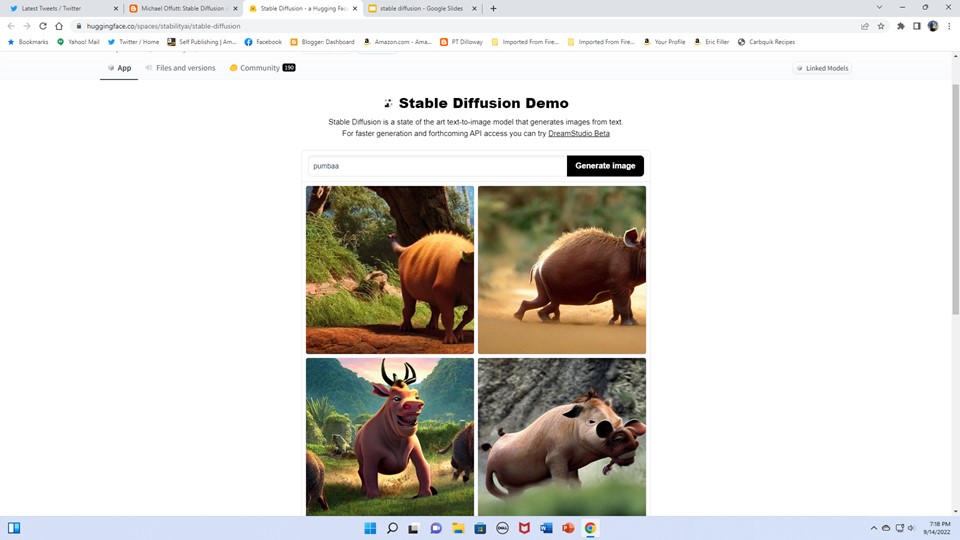
Last week, Michael Offutt posted a link to this site called "Stable Diffusion" that lets you put in keywords and an AI program generates 2-4 pictures based on what you write.  I decided to try it to look for some things I was looking for on stock photo sites and then just some other random stuff.

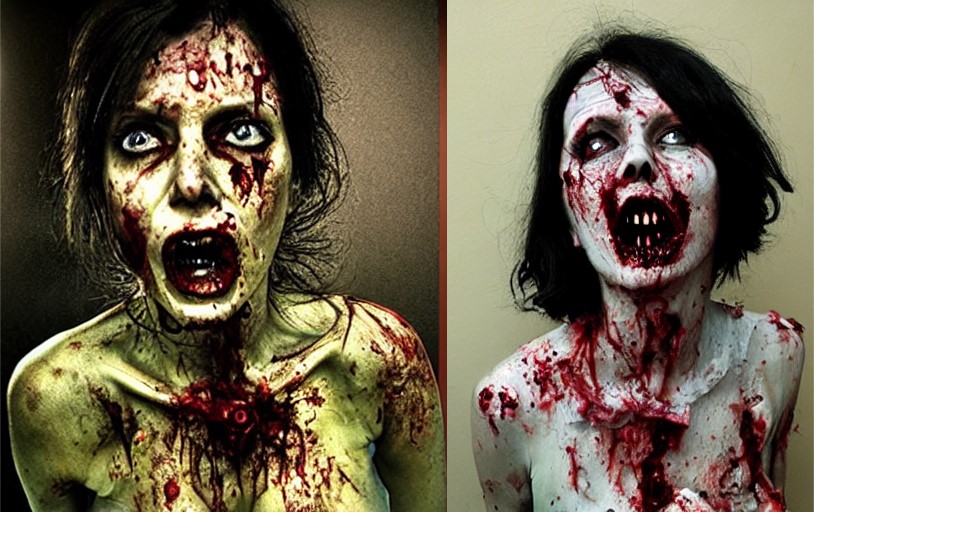
The results were mixed.  Sometimes it comes up with something pretty brilliant and other times it comes up with something pretty horrible.  And sometimes it doesn't even show anything because it gets censored for being pornographic or racist or something.  Like one time I copied a description from a stock site like "woman in Santa hat with Maine Coon cat" and it got censored.  I think the "coon" part was prompting it to do something racist.  Weird.  Here's an early sampler of three searches:


And when I asked it to draw a warthog, it came up with nightmare beasts instead.  That seems pretty weird that it doesn't know what animals look like.  When I just put in "Pumbaa" it came out with weird creatures that were more cartoony but still creepy.


I did another little test, trying to describe the cover for A Hero's Journey to see what it would draw.  The four results and the original picture are here:


A couple aren't terrible, especially the first one, though they aren't really what I asked for.  So Rusty Webb 1, AI 0.

I think the best results come if you're not asking it to do people or animals.  It can do almost photo-quality landscapes:


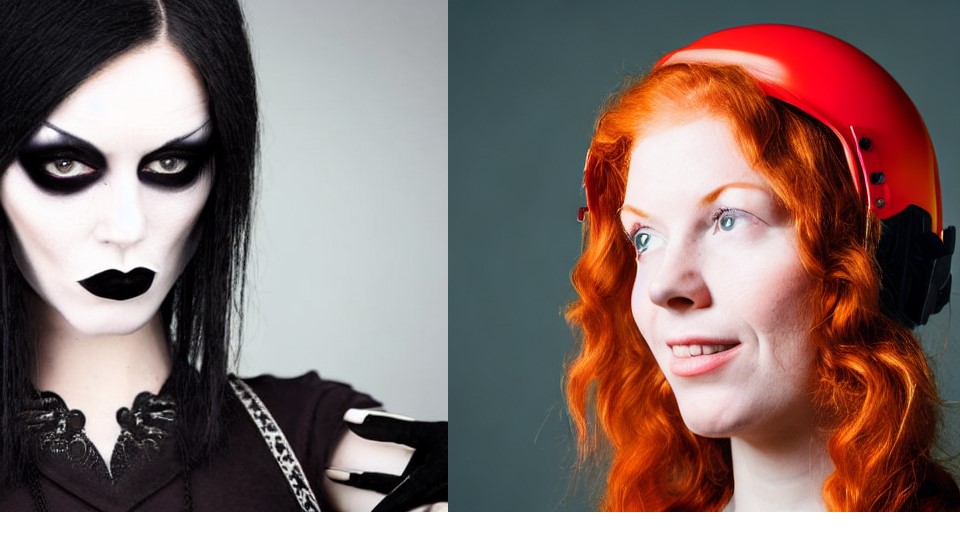
For people I think it did better telling it to do a close-up:


Telling it to do a portrait would sometimes generate something like a painting, but it also came up with some decent results:


Sometimes it would do a mostly-good image, but it would do something weird with the mouth or especially with the eyes.  It's not always just "Uncanny Valley" so much as it gets kind of lazy and just doesn't do both of them consistently.

The larger one on the right looks like an android.  Of the other four a couple are pretty good and a couple, not so much.


No idea why it did the first one in mostly sepia but it's neat.  The second was good except for the "freckles" that are like a rash on one cheek.

I like the first one except for the purple and blue "freckles."  The second the eyes are a little weird.

The interesting thing to me is that it was kind of like searching stock photo sites.  So many times to try to find what I want, I have to plug in keyword after keyword to find something I want.  In the same way you might have to keep changing your keywords to get it to generate something that's usable.  Like with stock photo sites, it can be really hard for it to get what it is I'm looking for.  So I often have to keep trying different phrases, hoping that one of them will unlock a decent result.

Like I started looking for an "African American female superhero" and it gave me weird cartoony drawings--a couple maybe a little racist.  Then I asked for something like "Black woman in mask" and it drew black women in Covid masks.  Then I changed it to "Black woman in superhero mask" and it came up with a couple of decent ones.  So like with stock photo sites, you have to refine your search terms until you maybe hit paydirt.

Obviously it's not going to replace artists right away, but it's probably a start.  Before it can really replace humans it needs to get a little smarter.  And if you wanted it to do comics or anything like that it'd have to be able to make things consistently; you couldn't have the thing spitting out completely different looks of the main character for every frame.

Anyway, since this is free to use for right now it does add another possibility for when I'm looking for something to use on covers and such.  

Friday, September 16, 2022

Sometimes First Person Is the Worst Person to Narrate

 Back in July I read this book called Diving Into the Wreck that I got for free so I wasn't expecting a whole lot.  While it was OK, I think what really held it up was that it was written in first person.  I'm not a John Oberon type who thinks you should ONLY write in third-person omniscient past tense; I write in first-person all the time.  The problem is that in some cases first-person just does not work.

In this case a lot of the problem is our character doesn't have a name.  She's referred to as "Boss."  Which, OK, that can work in movies like Layer Cake or The Ghost Writer where the main character is never named, but we can see Daniel Craig and Ewan McGregor so we know what they look like and all that.  Maybe it works in the books those are based on. 

So we don't have a name for the character and being first-person it's hard to describe her unless you use some really clumsy narration like having her say, "I put my blonde hair back into a ponytail and applied makeup around my blue eyes."  That sounds really forced and fortunately the author doesn't do that.  But the problem is by not doing that and using first-person, I really have no idea who this person is or what she looks like or more than the vaguest idea of how old she is.  She left home in her teens and she's been "diving" for at least 20 years so she's probably 35-45...I think.  Like I say in my review, all I can picture is kind of a fuzzy image like when a news show is hiding someone's identity.  It's funny looking at the different editions on Goodreads that not even the cover artists can seem to decide what she looks like as there are 3 different versions:

The other problem in a sci-fi book like this with first-person is there's so much about this universe that doesn't really make sense.  Boss is a "diver" who explores old spaceships and stations.  And apparently this is at least 5000 years in the future.  Yet a lot of the tech is worse than what our astronauts in 2022 have.  Why are they wearing flimsy suits that can kill them if they get cut and only have an hour or two of air?   A drone you can get for $40 on Amazon could probably do more and much safer.  Then there's this "stealth tech" that no one knows how it works even though it was invented by humans.  So there must have been some kind of big disaster or war?  Um...maybe.

See the problem with first-person is it's not natural for the character to give readers the details they really need.  Like what she looks like or how old she is or in the case of a sci-fi universe, why things are the way they are.  It would sound really weird and fake if she did tell you all that stuff.  At the same time, by leaving it all out, I'm just confused and unable to really connect with the character and the universe.

A lot of it might have been forgiven if there were some humor or romance or...much of anything.  There's a little intrigue concerning her father and "stealth tech" but not enough to really sustain it.  Part of the problem might have been this "novel" was actually three novellas then put together into one book.  It would have been hard to have much of a romantic plot with three separate stories later jammed into one book.  But there could still have been some more humor and fun.  I really wanted more Indiana Jones in Space and less poor man's 2001.  That's not entirely the author's fault; I mean I've talked about reader expectations before.  It's just if you're not going to give me what I want, at least give me something else that is interesting.

Anyway, especially if you're writing sci-fi or fantasy, first-person might not be the best way to go about it, because it limits your options.  Choose wisely.

LinkWithin

Related Posts Plugin for WordPress, Blogger...