Wednesday, September 16, 2020

Revisitations

 Last entry I talked about how I recently reread A Hero's Journey and it would be really nice if you went and commented on which cover you like if you haven't already.

Besides that, I also reread most of my other superhero stories.  I didn't reread the rest of the Scarlet Knight books yet and I didn't reread The Night's Legacy because I don't have it in paperback.

The thing is though that when you reread something after a few years it really does help you to see it with fresh eyes.  But still since I wrote them of course I didn't think any of them were bad.  But here are a few thoughts based on what I reread.


Girl Power:
  After rereading A Hero's Journey, I started in on my next superhero series with Girl Power.  The not-so-secret origin of it was I thought of doing a crossover between the Scarlet Knight and Chances Are series.  But since no one had probably read both series besides me, it seemed pointless.  But then I had the idea to do a crossover of the core concepts, so it's about gender swapped superheroes.  Characters who are based on Superman, Batman, Aquaman, and the Flash (Wally West more than Barry Allen) are turned into women and have to deal with sexism, changing relationships, and in Batman's case losing his strength when his body is de-aged into a teenager.

One criticism that's been hurled at this is the story isn't deep enough.  And I think that's valid.  Of course what those people don't know that I do is this was pretty much written as a lark, so I wasn't probably taking it as seriously as I could.  I wasn't sure I'd do anything with this (much less write two more, 7 short stories, and a spinoff novella) so I wasn't really interested in making it overly long.

Starla, the Superman character, gets the short end of the stick in this in that she doesn't get as much character development as the others.  She has to deal with a sexist boss and then her often one-sided friendship with the Lois Lane character, but it's not really as dramatic as with the others.  

Other than that, I always have the vague thought I should have done something more in the ending battle.  More like what?  I don't really know.


The Impostors:
  Book 2 of the Girl Power series was actually my favorite of the ones I reread.  I took it more seriously this time and so there is a lot more of a story.  Since Starla didn't get as much of a story in the first book, she gets a lot more story in this one.  It sort of follows Superman II where he decides to give up his powers.  In this case after some soldiers die, Starla blames herself and when the Lois Lane character questions her fitness as a hero, she goes to her Fortress of Solitude and takes something to become a normal human.

Soon she runs into some trouble in the city and is saved by a nice old woman who takes her in and she essentially starts a new life.  In the process she ends up falling in love with the Jimmy Olsen character--and him with her.  

Meanwhile, the other heroes are trying to make up for her absence as giant robots attack.  But then they're saved by themselves--or clones of their male selves.  There's some awkwardness when they try to work together, but soon the public decides to put their trust in the male team.  Aquaman and the Flash are de-powered and have to undertake desperate measures to get their powers back.  And once she realizes that her male clone is not as benevolent as her, Starla has to risk everything to get her powers back.

Really the only thing I didn't like is like a lot of Marvel movies the ultimate villain is under-developed.  There are some mentions along the way but since I kept him in the shadows until the end, he didn't really get much in the way of development.


League of Evil:
  At the end of book 2 there's a mysterious message that threatens something terrible is coming.  For what was supposed to be the final story, I wanted something big and you don't get much bigger than a Galactus/Unicron-type planet killer.

But before that there's a lot of other stuff to dispose of our heroes and create epic chaos.  The weapon that was used to turn our heroes into heroines in book 1 is used on the whole world, turning everyone into women.  Before that, Starla is arrested and taken deep into space by a group sort of like the Green Lantern, the Flashes are sent into a future where the Earth has been wiped of all human and animal life, and the Batman character is locked in an asylum and replaced with her clone from book 2.  

This leaves Earth defenseless as villains begin taking over.  To combat the chaos, the Batman character's sidekick Melanie recruits four villains to serve as sort of a Suicide Squad to fight the other bad guys.  They start out as just four bad guys and eventually become a real team.

But just as they seem to get things in-hand and the other heroes start coming back, here comes Galactus!  

There were so many moving parts in this story that I think it was a bit unwieldy.  Global catastrophe is really hard to pull off.  And like some later books there were probably too many changes, especially with the Flash characters.  And there is sort of a deus ex machina involving one Flash and time travel.  In the end it all falls back on the favorite superhero movie ending of 2012:  a hero takes a bomb somewhere to save the day.

I just think the Suicide Squad thing could have worked better on a smaller scale but like with the Scarlet Knight series, when you're doing what's supposed to be the last book, go big or go home.


Secret Origins:
  It was natural then I'd read the Eric Filler version of the Girl Power series next.  The secret origin of Secret Origins actually came when I was in the theater for BvS and I thought:  what if the Batman and Superman characters were turned into girls who had to go back to high school?  Because that's a thing I'd think about.

Unlike the Girl Power books, this was written in first person from the POV of the Batman character.  Like in BvS they are not really superfriends, though most of the loathing is on Batman's side.  When a big space rock threatens the Earth, they intercept it and some kind of mysterious radiation turns them into teenage girls.  While the Batman character is a wimpy nerd, the Superman character soon turns into a gorgeous Barbie doll.

They go to high school and of course the Superman character becomes part of the popular cheerleader crowd while the Batman character is a social outcast.  As the Superman character becomes more popular, it starts going to her head both as a normal girl and a superhero.  Then there's a Carrie-type incident that prompts her to snap and the Batman character has to stop her.  Then they have to work together when that rock that changed them turns out to be an egg for a giant monster!

This was more tightly-plotted than Girl Power and I thought it was pretty fun.  My favorite difference was the introduction of the Batman character's former sidekick, who's sort of like Nightwing, except he's black and gay.  Him being gay caused a rift between them, to the point that the Batman character tried to have him sent to military school.  After the Batman character changes, the former sidekick helps her to train and become a hero again and in that way they end up having a better relationship than when they were father and son.

Like in BvS, one problem at the end is when the big killer monster is released, there's not a ton for the Batman character to do.  She masterminds a strategy to get rid of the monster, but there's not a lot she can do in person, so maybe it's a little underwhelming.

Like a good superhero movie there was a sort of cookie scene at the end where we meet a new hero--the Flash-type character who's like the Flash-type character of the Girl Power series.


Speed Demons:
  the second book in the Gender Swap Heroes series focuses on the Flash character who was a scientist studying that space egg from the first book.  When it hatches, he's turned into a girl who has superspeed. 

My favorite part is the first quarter or so where Allison learns about her powers and has to scavenge resources to survive.  She steals money from bad guys and creates a lair in an old electrical company building, which was sort of cribbed from Darkman II.  At one point she runs up to a small town to hang out with some kids her own age, which doesn't go great.

Maybe it would have been better if the whole book had been that, but eventually there had to be a bigger plot.  That involves a rival who was also turned into a girl, one with the ability to siphon powers like Rogue or Parasite.  When she siphons Allison's powers and then the Superman character's powers, she turns into a supervillain who tries to overthrow the US government.

I think things got a little out of hand with the plot considering how it started.  Maybe I should do a new version independent of these where I try to keep it smaller.


Resistance:
  the end of the second book set up this third book.  After the supervillain wrecks DC and kills a bunch of people, the government decides it needs its own heroes to fight back.  The first one is one of the soldiers who survived the attack, though he was badly wounded.

He takes an experimental serum that turns him into a teenage girl with invulnerable skin and super strength, sort of like a hot teenage girl version of Captain America.  The government can't find any other willing volunteers so they offer pardons to four military criminals who then get the serum.  Three of them survive.  One has fire powers, one has telekinesis, and one turns into a girl made of crystal.  It's then kind of like League of Evil where they have to work together to become a team and take down our heroes from the other stories.

But that's only about half the book.  Then it really goes off the rails as our characters are de-powered by the government, rescued by the Batman character, and then get new powers in time to fight off an alien invasion.  Like I said it goes off the rails and the biggest problem is two of the makeshift Suicide Squad, especially the Human Torch one, don't really get a satisfying end to their character arcs.  Mostly the end focuses on Captain America, Marvel Girl, and Superman as they team up to fight the alien fleet.

It was my least favorite of the lot but someone on Amazon actually thought it was better, so who's to say?


Justice for All:
 
the last one of this batch was the 2015 P.T. Dilloway novel Justice for All, Book 1 (and only) of The Outcast.  I sort of reused the Batman character from Girl Power only she's a girl the whole time.  

Robin Howe's police captain father is blown up in front of her by goons of the evil Madame Crimson.  After that she vows to get revenge.  She begins training to become a vigilante and after a year takes down a couple of low-level mob guys before getting in over her head and nearly killed.

After getting out of the hospital, she's sent to a strict Catholic all girl's school in New Hampshire under the name Rose Howard.  But she soon finds out the resident Mean Girl at the school is none other than Madame Crimson's spoiled daughter!  As Robin tries to adjust to her new school and makes friends with another girl and a local boy, she ends up having to save Madame Crimson's daughter from another gangster's goons.

This is a pretty down-to-earth series with no magic armor or gender swapping or anything like that.  I don't think it's overly "realistic" and like some movies I wonder if the teen characters maybe talk too much like adults.  The end probably needed a bigger set piece too.

So there you go.  At some point I might go ahead and read the rest of the Scarlet Knight books.  Or maybe I'll get off my ass and write something.  Or maybe I'll die of Covid.  In 2020, who knows?

Monday, September 14, 2020

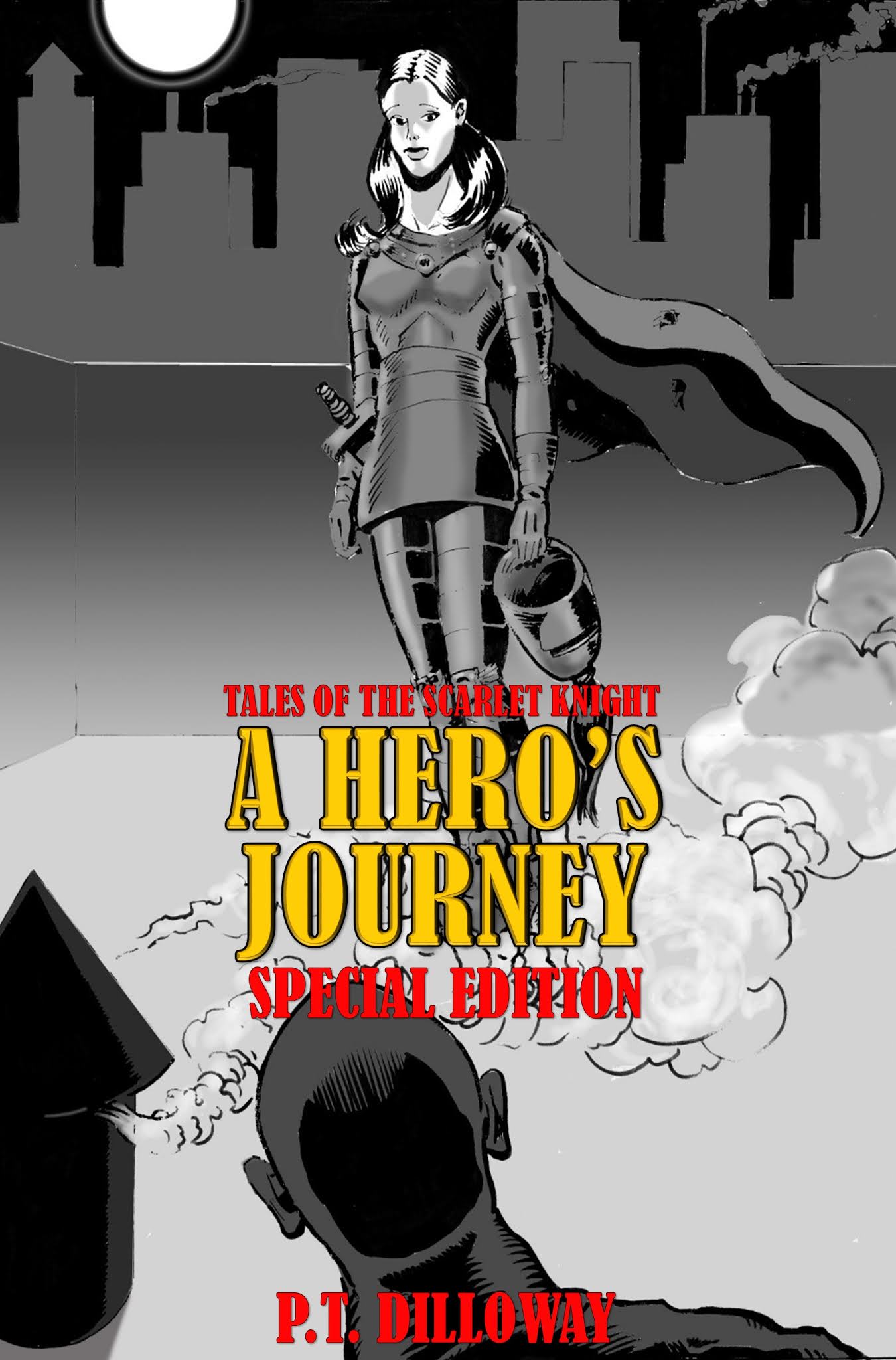
A Hero's Journey: Release the Grumpy Bulldog Cut!

Recently I ran out of comic books to read and I didn't feel like writing, so I decided to read a book.  Then just for the hell of it I thought, "Why not read one of my books?"  I decided it'd be better to read a paper book than a Kindle one, so I grabbed A Hero's Journey off the shelf.

Reading it for the first time in a few years, I was reminded of how much stuff I cut out for the eventual published version.  With all this "Snyder Cut" bullshit going on, I began to think that maybe I should edit and release the full version.  Which is not the "original" version. 

The version I released was the third version, or the fourth if you count the graphic novel script I half-ass wrote.  The first version was written in 2009 and I didn't really like it.  To me there seemed to be some plot holes and stuff.  So I did a second version that was first-person from the POV of the ghost Marlin, but that was fraught with all sorts of problems and it would be hard to do that as a series.  But I left it while I wrote the rest of the series.  Then in 2010 I went back and wrote a new version that was 133,000 words because there was a lot of extra stuff, some of which you can find in the Deleted Scenes posted to the blog.  

But when I was trying to get it published I decided to cut it down to a more salable length.  I pared it down all the way to 86,000 words, so that was like 47,000 words cut!  Practically a whole short novel of stuff cut out.  

Reading the shortened version, I think Becky and Lieutenant Donovan got the worst of it as I think a lot of their scenes were cut.  There was also a prologue at the beginning about how the case containing the Black Dragoon armor came to America.

Anyway, I found the original draft of that version and formatted it for an ebook that I'll probably start editing soon.  Then I can make a new paperback of it too.  The paperback I read actually isn't that great.  There are a couple of weird parts where a sentence posted backwards!  !siht ekil sdrawkcab  I'm not sure how that happened, if it was on my end or Amazon's end--or Createspace, whatever it was.  

As part of that of course I want to do a new cover.  I'm sure Rusty Webb is too busy in Bermuda to do a new one for me, so I was trying to do a more traditional one.

Here's one just using some free images:


And here are a couple using paid images.  I haven't bought them yet so they're just previews with the lines and watermark junk on them.


You like any of those?  I could probably find a new background for the three of those; that was just something I had on hand.

And here's a different direction, using a splash page from the teaser comic drawn by Al Sirois:


I'm sure Al wouldn't mind if I use that, though I'd make sure to ask.

Any of those strike your fancy? 

Thursday, September 3, 2020

IWSG Analysis

Yesterday was the Insecure Writer's Support Group.  Most of the time it's not very interesting, but I did find the question for September to be fairly interesting:

If you could have one author, living or dead, be your beta reader, who would it be?

From reading Michael Offutt and Tony Laplume's responses, I don't think they really gave this question enough consideration.  Mostly they seemed to just pick someone they liked:  Guillermo del Toro and Roberto Bolano respectively.

The thing is, a beta reader is like a mentor, someone more experienced than you who's going to help you improve your writing.  If I simply pick based on my favorite author, I'd pick John Irving of course.  You know that if you've read this blog or previous ones for a while.

But would I really want him as my mentor?  I don't think so.  Mostly because I think he'd probably be kind of a jerk.  And I'm kind of a jerk, so two jerks trying to work together wouldn't work very well.

I don't know some of my other favorite authors well enough to know how well I might get along with them.  Other famous authors have their own problems, like Faulkner and Chandler (and many others) had problems with alcohol.  Others had problems with drugs and so on.

Let's say I go with another of my favorites:  Lawrence Block.  The first problem is that right now he's like 85.  But since I can pick anyone, anytime, maybe I can use my Bill & Ted phone booth to go back and scoop him up from another time.  I'd have to do some research though because at one time I think he had a problem with alcohol and at another (or the same time) had marital troubles, so I wouldn't want to scoop him up from those times.

Anyway, it sounds like a simple question, but maybe all the people not reading this can see how complicated it is.  To find your beta reader, your Jedi Master, you need to think about more than just someone whose work you like.  You have to consider them as a person and how they might form a decent partnership with you.

Maybe I'm just overthinking a frivolous question.  Or not.

Thursday, August 20, 2020

Pandemic Comics

Besides my own books, almost all of my reading during the pandemic has been comic books.  Because they're short and easy to pick up and put down at will.  I didn't go to comic book stores before that but since those were closed my two sources were Comixology and Amazon Prime.

On Amazon Prime they have a lot of Marvel's Star Wars ones.  I already had read the Darth Vader and Doctor Aphra series on Amazon Prime.  There were a couple of other ones I hadn't read yet.

Having watched Clone Wars and Rebels on Disney+, I decided to read a couple of standalone miniseries Darth Maul comics.  The Darth Maul series by Cullen Bunn takes place before Episode I.  Impatient with waiting and wanting a challenge, Maul abducts a Jedi Padawan and duels with her.  This gives him a new respect for his enemies.  This miniseries was OK, though not as good as the TV shows.  Better was the one called Darth Maul:  Son of Dathomir.  It takes place after Palpatine defeated Maul on Mandalore.  Maul attempts to rebuild his criminal empire, which would lead into his cameo in the Solo movie.  This one wasn't bad, though if you hadn't watched Clone Wars recently then it might have been a little confusing.

The other Star Wars series was the Poe Dameron series.  Oddly Amazon Prime had volumes 2-4 to borrow but I had to buy the first volume from Comixology.  So I waited until it went on sale and then bought it.  It's a fun series that like the Star Wars Resistance show tries to fill in some blanks between Return of the Jedi and Force Awakens

It starts shortly before Episode VII with Leia giving Poe command of Black Squadron, which is just 4 fighters for the most part.  She sends them to look for Lor San Tekka, the guy played by Max von Syndow.  They have a couple of near misses where they get in trouble with Hutts and the First Order.  One particular First Order officer named Terex, a former Stormtrooper-turned-pirate-turned-First Order officer, makes it his mission to hunt down Poe, until he gets a cyborg implant installed by the First Order that basically lobotomizes him.  After freeing himself of that, Terex decides to go back to piracy to explain why we don't see him again.

Meanwhile Poe and company have to help Leia rescue Tekka after he was captured.  For the most part the series was fun.  On the whole more fun than Doctor Aphra, which as I said before was only fun in the first two volumes.  The fifth volume, which I also had to buy when it was on sale, takes place after the Force Awakens.  The first issue mostly creates an explanation for how Poe got "thrown from the crash" of the TIE he and Finn stole while his jacket remained.  Basically the jacket got stuck and so he slipped out of it when he escaped.  Then some friendly aliens gave him a lift back to the Resistance base.  Because why not?  The rest of the volume mostly follows the rest of Black Squadron as Leia sends them to recruit allies after the destruction of Starkiller Base.  That's to explain why they weren't in The Last Jedi.  The squadron goes to a couple of planets but only run into First Order forces until Poe borrows a fighter from a Hutt to rescue them.  This wasn't all that good because like Rise of Skywalker and Resistance it was trying to fix what Rian Johnson broke.  It makes sense that after that volume they cancelled the series altogether.

Besides that I got a couple other Marvel ones from Amazon Prime

The first two volumes of Captain America by Ta-Nehisi Coates.  Like I said in my Goodreads review it was a bold move to hand over the whitest superhero to a black author.  The only real drawback to these 12 issues is that it takes place after the "Secret Empire" thing that I hadn't read.  I got the gist that thanks to the Cosmic Cube Steve Rogers was a secret Hydra agent who somehow took over America until he was stopped and a different Steve Rogers came back to replace him.

So in this Steve Rogers is back and trying to be Captain America, but America doesn't really trust him.  Things get worse when someone is murdered and the weapon appears to be Captain America's shield.  Steve surrenders himself and ends up in prison until Sharon Carter and the "Daughters of Liberty" help him to break out.  At some point I should get some more of the series to see how Steve can redeem his good name--if he can.

Black Widow: Deadly Origin was a meh miniseries that was probably free on Amazon Prime because the movie was supposed to come out this summer.  Natasha Romanoff and her friend/lover/husband Ivan are injected with something back in the 50s that allows them to not age as fast.  In the present someone is using nanobots or something to turn Black Widow's allies against her.  And then somehow she blasts off into space to fight Robo-Ivan.  Like a lot of Black Widow comics, this hasn't really had any lasting impact, at least I don't think so.  If we can ever see the movie, maybe it'll prove otherwise.

I also bought a couple of Transformers comics that were on sale and I hadn't caught up on.  Unicron was the conclusion of IDW's Transformers series before it was rebooted to correspond to the new series of toys.  It gets most of the Hasbro-verse of GI Joe, Rom, and Visionaries into it as Unicron threatens to destroy the universe until they sort of poison Cybertron to kill him.  Hooray.  Requiem of the Wreckers was a second sequel to Last Stand of the Wreckers.  The Wreckers were sort of an Autobot version of SEAL Team 6 or Delta Force.  This last double-stuffed issue doesn't really add much and wasn't really necessary.

Two of my favorite series were from Marvel, which is unusual for me.

Spider-Man: Life Story was a neat 6-part series.  Each issue checks into a certain decade of Peter Parker's life.  The first issue takes place in the mid-60s with Peter dealing with issues relating to Vietnam.  Then the second issue takes place in the 70s.  And so on with Peter aging normally so that by the last issue in the 2010s, he's an old man going on one final mission to save humanity with the new Spider-Man, Miles Morales.  It works in a lot of the most famous Spider-Man stories like the death of Gwen Stacy, the black parasite suit, the Clone Saga, and Civil War.  Because it's only six issues it has to compress and mash up some things that I don't think work as well as they could, but overall it was a great read even for casual Spidey fans.

The Immortal Hulk is an ongoing reboot Hulk series by Al Ewing.  In the dumb Civil War II story Hawkeye kills Bruce Banner--at Bruce's request when he thinks he's going to turn back into the Hulk.  This series starts off like the old TV show with Bruce having risen from the dead and traveling discreetly around the country, searching for places affected by gamma radiation.  There's also a reporter who is on his trail.

Eventually Bruce's Hulk gets into a fight with Sasquatch, the Canadian Hulk-like hero.  And then somehow he winds up in a weird gamma radiation Hell called "the Green Door."  Emerging from that, Bruce and the Hulk take over a shadowy government agency.  Most of it was good, though it was a little disappointing when it starts veering from the more down-to-Earth first issues to weirder stuff, especially the last issue where some alien race at the end of time is trying to create something to destroy the Hulk, who by then has killed the rest of the universe or something.  It's a lot like Grant Morrison's New 52 run on Action Comics where it started off as a pretty grounded Superman story and then just kept getting farther away from that, so I'm a little wary about continuing this series, but I'd probably try at least one more volume.

A couple more odds-and-ends:

Nightwing: The New Order is an Elseworlds comic where Nightwing uses an alien weapon to take away superpowers from everyone.  He starts his own not-so-secret police force, but then things start falling apart when his own son is diagnosed as having the metahuman gene.  He has to run from his own police force and join with some of the few heroes left to make things right.  There are some good concepts but it wasn't really given enough time to fully explore them.  The superhumans losing their powers was done better in Tom King's novel A Once Crowded Sky.  The thing with his son is like in the Amazon TV series The Man in the High Castle.  Just saying.

Spider-Man and the X-Men takes place after Wolverine "dies" and Spider-Man takes over teaching for him at the Jean Grey School for Mutants or whatever it's called.  Spidey and his class of misfit kids have some wacky adventures and run into trouble with villains and heroes alike.  It's fun but not really essential reading.

Superior Spider-Man: Full Otto:  The original Superior Spider-Man was about Otto Octavius (aka Doctor Octopus) taking over Peter Parker's body and becoming a "superior" Spidey.  This new version takes place after some thing with clones where Doc Ock gets a sexy new non-Peter Parker body and goes to San Francisco to become a superior Spider-Man.  It of course doesn't go that well.  It was OK but not as good as the original series.  Maybe if more issues were on Amazon Prime or something I'd read them but not something I'd pay a lot of money for.

And a couple of smaller press comics:

Freshmen was a series from the 2000s co-created by Seth Green of Family Guy and Robot Chicken infamy.  As you'd guess then, it's kind of a foul-mouthed, potty humor take on superheroes.  A bunch of freshmen are near a science lab when an experiment goes wrong and gives them powers.  Not necessarily traditional powers.  One couple only has powers when they're near each other.  One guy's "power" is having a really huge dong.  And so on.  The nerdy kid who really wanted superpowers wasn't around at that time to get any, but he tries to use his knowledge as the team leader.  It was OK but not really great.  As funny as they might be, some of the "superpowers" really had no practical application.  For decency reasons the guy with the huge dong couldn't really be involved much so they finally just wrote him off by saying he went out to Hollywood to work in porn.  With a little better planning it could have been better.

Die is a series my Blogger buddy Arion turned me on to.  It's like a gritty version of the old Dungeons & Dragons cartoon series.  That was about a group of kids who are transported to a fantasy world based on Dungeons & Dragons and they have to find their way home.  In this case a group of British kids were transported to a fantasy world a long time ago.  They came back--except for one of them--but many years later they're brought back to the fantasy world and have to deal with the consequences of what happened back then.  Interestingly one of the dudes in the real world seems to be a girl in the fantasy world, which isn't really explained.  At some point I need to look for the continuation of the series.

There you go, a lot of pointless rambling about comics.  Because, why not?

Tuesday, August 18, 2020

DC's Other Snyderverse Isn't Much Better

DC fans who use the term "Snyderverse" are typically referring to the 2 1/2 movies made by Zack Snyder:  Man of Steel, BvS, and Justice League.  (Maybe Watchmen though it's not really connected.)  While moderately successful financially the movies were mostly panned by critics and a lot of moviegoers.  But DC Comics has another Snyderverse in the comics of Scott Snyder and to be honest it's not a lot better.

Scott Snyder first gained recognition as part of DC's Vertigo imprint.  He also did a couple of stories for Batman when it was Dick Grayson in the costume.  But in 2011 when they unleashed the "New 52" Snyder took over the main Batman title.

The first storyline for that was the Court of Owls.  I talked about it in a couple of my early blog entries back in 2012.  I got the first volume free from Amazon Vine and liked it enough that I bought the rest of the story.  A brief summary is that the Court of Owls is an ancient society of rich Gothamites who secretly use their money and influence to control the city.  Not even Batman knew about them until Bruce Wayne's plans for the cities finally caused the Owls to target him

So Snyder's Batman run started out pretty good--to me anyway.  And plenty of other people not named Tony Laplume.  But after that it pretty much fell off.  First there was the disappointing "Death of the Family" story arc where the Joker takes Batman's allies hostage for...reasons and...really does nothing.  I think part of the flat ending was because the current Robin who might have been killed in that story wound up being killed in the Batman Incorporated title--for about five minutes until he was brought back.

Recently I read the "Zero Year" storyline and it was pretty lame.  It was Snyder's Batman origin story, which was a mashup of a bunch of other Batman stories:  Year One, Killing Joke, No Man's Land, Batman Forever, Batman Begins...maybe some other shit.  Bruce Wayne returns to the city and becomes Batman to take on the Red Hood Gang but behind the scenes the Riddler launches a plan to cut off Gotham and its power until Batman can stop him.  It was...really dumb.  Like I said there are so many things it seems to mash in there so it feels like a lot of stuff you've seen before only done better.

After that came the "Endgame" storyline where the Joker returns to unleash a killer Joker virus on Gotham--and the Justice League.  That ends with Batman seemingly dying to kill the Joker, though really Bruce Wayne just has amnesia about being Batman.  That was OK but not really great.

While Bruce has amnesia, Commissioner Gordon takes over as Batman in some kind of robot suit.  This was during the almost entirely forgettable era between New 52 and Rebirth where Batman wasn't Batman, Superman didn't really have powers, Wonder Woman had pants, and...some other shit no one cared about.  I think the only thing that really survived for a time was the "Batgirl of Burnside" thing with the purple suit that was pretty neat even if I found the comics meh.

Unlike Azrael Batman or Dick Grayson Batman, Robo-Bat doesn't get much time to prove his worth.  He doesn't take on any iconic bad guys like Joker, Two-Face, Penguin, Riddler, or Mr. Freeze.  He takes out a couple of superpowered henchmen of "Mr. Bloom" before getting his butt kicked by Bloom.  Who is...don't know.  And he wants...something.  For...reasons.  Since Robo-Bat totally sucks, Bruce Wayne downloads a bunch of old memories into his head and then get a new costume and defeats Bloom with Robo-Bat's help.  It might have worked better if it had been given more issues to develop Gordon's Robo-Bat and develop Bloom, but I guess they were kind of on a compressed timeline with Rebirth coming after issue 52.  So they only had about ten issues to introduce Robo-Bat, get rid of him, and bring back Bruce Wayne.  AzBats and Dick Grayson got a lot longer than that to win over readers--or not.

Of course at the end of Snyder's run Bruce Wayne becomes Batman again, surprising...no one.  I mean it's like when Bruce Wayne, Clark Kent, or Steve Rogers "dies" or "retires" you know they aren't going to stay dead or retired or whatever.  That's just how comics are.

Amidst all this was also the 52-issue weekly series Batman Eternal.  It was better than some of Snyder's regular Batman stories.  Still not the greatest thing ever.  It worked in a lot of Bat villains like most of the traditional ones and more recent ones like Bane and Hush.

Snyder also wrote a Superman limited series Superman Unchained that was just another story about Superman fighting some alien dude who pretty much has the same powers as him.  Only I don't think this time it was actually Kryptonian.  Still, not overly original or anything.

After his run on Batman ended, Snyder did a big event series Dark Knights: Metal, which I found really, really dumb.  It introduces something called a "Dark Multiverse" with a bunch of evil Batmen led by "the Batman Who Laughs" or a Joker-ized Batman who looks like a bad guy from Hellraiser.

Unfortunately a lot of other people didn't hate that so Snyder got moved up to the Justice League title.  Which I haven't read because it seems stupid as it spins off from that stupid Metal thing.  I did recently read a couple of other things from Snyder.  The 12-issue Batman Who Laughs comic didn't really provide any insight into the Batman Who Laughs.  Mostly it's just about regular Batman who gets dosed with Joker gas and so starts becoming A Batman Who Laughs but has to stop the original Batman Who Laughs and his henchman the "Grim Knight" that's one of those lame Punisher-type Batmen.  It was boring and lame because like I said, it didn't really provide any insight into the characters.

I also read the double-sized single issue Tales of the Dark Multiverse #1 only because it was supposed to be about a universe where Azrael defeated Bruce Wayne to remain Batman.  It was really disappointing because it somehow wound up being a Bruce Wayne story and not an Azrael story.  Basically Azrael keeps Bruce Wayne's head and torso alive somehow to torture him for 30 years while maintaining a tight hold on Gotham.  But then Bane's son and some other people rescue Bruce and use some kind of nanobots to restore his limbs and so he becomes a brutal, killing Batman.  Whatever.  I guess I shouldn't have expected Snyder to have any insight into a character he never really wrote until then.

Because it was on sale I also read Last Knight on Earth that was kind of like a Batman-themed version of Old Man Logan.  Except instead of an old man, Batman is a young clone of the original Bruce Wayne.  This was something Snyder mentioned in the regular Batman comic; the cloning machine is how Bruce got his memories of being Batman back.  This then was taking that idea and using it more how it was supposed to be used.  He wakes up into a world that's been decimated for...reasons.  I mean I read all three super-sized issues and still didn't really get it.  Lex Luthor was doing...something and killed Superman...somehow and people went crazy for...reasons.  Accompanying Batman through the wastelands of the DC Universe is the severed head of the Joker that's in a glass jar and alive...somehow as sort of a sidekick.  It was...meh.  It was the rancid cherry on top of the garbage sundae that was most of Snyder's Batman run.

So other than the original Court of Owls and Batman Eternal, I haven't liked the comic book Snyderverse any more than the movie Snyderverse.  But there are plenty of people who do.  Unfortunately.  Like Zack Snyder, when you give Scott Snyder too much rope, he winds up going in strange, dumb directions.  They both need someone to keep them under control.

Thursday, August 13, 2020

Ad Wars 2

For the past month Pluto TV has been torturing me with this stupid commercial for MTV's Siesta Key.  Pretty much any channel, any commercial break you can see spoiled, entitled young white people partying and whining about...whatever.  Hoo-fucking-ray.  It's to the point where I mute or change the channel any time I can to avoid it.  Not that it really matters since I could probably recite it from memory by now.

The thing is, though, they can show me this commercial a billion fucking times and I just won't care.  I'm not going to watch that show.  Ever.  I'm not in the age demo the gender demo or any other demo.  Why keep advertising it to me?

It reminds me of when I first used Popcornflix on my Roku.  The entire movie I was watching they showed commercials for an HTC phone that starred Robert Downey Jr.  They had a couple of slight variations but basically the same commercial 3-4 times every commercial break for like 2 hours.

I can say that the ad was effective in that I remember what it was years later while I don't even remember what movie I was watching.  But no I didn't buy an HTC phone.  I didn't even look it up to possibly buy it.  I didn't care.  I didn't need a new smartphone so whether you show that ad once or one thousand times it makes no difference.

Another time, maybe for a different app, they did the same thing only with a Lexus commercial that didn't star anyone so I don't remember what specific car it was for.  But the same thing of 3-4 times every commercial break.  And it didn't matter.  You could show this ad once or one thousand times and it won't matter because I still can't afford a Lexus.

I get on traditional broadcast networks you have to just shotgun ads, but you'd think Internet apps could do a little better job.  I think even cable channels probably do a better job at tailoring commercials to their demographic.  Like I don't think you'll probably see a lot of tampon commercials on Spike TV or Spike TV commercials on Lifetime.  Not a lot of crossover right?

So maybe whoever's running Pluto TV should wonder how many people who are watching Mystery Science Theater 3000, Rifftrax, Star Trek, or the Sci-Fi channel are in the age/gender demo for Siesta Key.  Or other MTV reality shows.  Or VH1 or BET reality shows.  I'd wager there's not a huge crossover.  Even without age/gender demos, all those channels I watch feature scripted shows, so why are you constantly advertising reality TV to me?  It seems pretty obvious to me.  I mean sure you get paid for showing ads, so maybe that's why they just shotgun them.  If you're the thing being advertised, though, maybe it's time you insist on your money being spent better.

Tuesday, August 11, 2020

Missed Connections

Recently I was rewatching Star Trek: The Next Generation on Amazon Prime.  Like when I rewatched Earth Final Conflict they had been showing it on Pluto TV but it's more expedient to watch it on Amazon without the commercials.

Anyway, there were a couple of times when there was stuff that didn't really add up with stuff that had happened earlier.  The first time I thought that was in an early 6th season episode when the neurotic Lieutenant Barclay thinks he sees some kind of monster in the transporter beam.  At one point when Barclay is nervous about transporting, Geordi LaForge tells him about how transporter accidents hardly ever happen.

The thing about that is only 4 episodes earlier (though admittedly it was in the previous season) LaForge and Ensign Ro were believed to be dead when a transporter accident put them out of phase with the rest of the universe.  So it's like, wait, why are you saying how safe these are when just a few episodes ago you had a transporter accident?  You of all people should know how dangerous transporters can be.  It would have been nice to have referenced that.

A couple of episodes later a girl named Amanda Rogers comes on the Enterprise as an intern.  But soon it's found out her parents were part of the Q Continuum and as a result she has pretty much god-like powers.  She gets a crush on Commander Riker and at one point beams him into a romantic fantasy.

The thing about what happens between them is that back in the first season, Q gave Riker powers like his, or like Amanda Rogers's.  So he of all people could relate to what she was going through.  But there's no mention of that at all.

In the seventh season there's a planet with a primitive culture where Worf's human brother is stationed as a hidden observer.  The planet's atmosphere is disappearing and Picard is going to just let all the people die because the "Prime Directive" says they can't interfere.  Worf's brother uses a holodeck simulation though to convince the people they're still on the planet when they're actually on the ship.  They go through a "Journey" to a new home, which is actually an uninhabited planet.

The thing is, there was a second season episode where they found a colony that had been started long ago by humans who left Earth in the 21st or 22nd Century.  The culture had regressed to about 17th Century technology.  Their planet was dying so without any crap about the "Prime Directive" Picard beamed them up into the cargo bay and wound up taking them to another planet from that same expedition that had a more advanced civilization populated by clones in dire need of new DNA.  So why was it OK in one episode to move primitive people off a planet and not another?  It didn't make much sense to me.

That's not to say the show has sloppy writing all the time; they are plenty of times when they do reference stuff that happened before.  But when you have a show like that, there are plenty of different writers and so they might not all know every aspect of the continuity.  And it's really a lot easier to notice these things when you're binge watching than when you're watching these episodes weeks, months, or even years apart.

This same thing happens sometimes in stories.  Especially stories that are longer and I might have started writing weeks or months ago.  A recent case in Swapp:  Jailbreak was near the beginning I referenced some guns the good guys had in their headquarters.  But near the end when the good guys are taken captive in their headquarters there's no mention of the guns.  Why?  Because I'd forgotten about them.  So when I was editing (basically binge reading) I saw that first part and thought, Wait, what happened to that?  I eliminated the reference to the guns because that was easier than rewriting an entire scene to work them in.

In extreme examples you can have entire characters or plot lines that just get forgotten.  That's why it's always good to edit so maybe you can see some of these things that you missed.  Nobody's perfect.

Thursday, August 6, 2020

Did I Outgrow Robot Chicken or Did It Outgrow Me?

Probably no one who reads this blog watched Robot Chicken, but it's been one of my favorite shows for about ten years.  Recently the show finished its 10th season since 2005 but I found I didn't enjoy it as much as many of the earlier seasons.

The show is on Cartoon Network's Adult Swim and each episode is only about 11 minutes long.  It uses stop motion puppets mostly of pop culture subjects in satirical skits.  A lot of the early ones featured 80s toy properties like Transformers, GI Joe, MASK, Thundercats, and Masters of the Universe.  Which as a child of the 80s really put it right in my wheelhouse.  They've also had specials dealing exclusively with Star Wars and DC Comics.

But this last season I noticed that a lot of the references were for things I didn't really know a lot about, like girl toys from the 2000s or 2010s maybe that my nieces would probably be better acquainted with.  Or references to shows on Netflix or wherever that I had never watched.  The thing about reference humor is that it works best if you're familiar with the reference.  Otherwise it might be amusing but I won't really GET it, you know?

It makes me wonder what happened.  I suppose part of it is that TV shows often have turnover with writers, so they probably brought in some new writers, maybe more younger and/or female writers who were familiar with properties and shows I was not familiar with.  And the other thing is I suppose there are only so many jokes you can get from those 80s properties and even 90s ones I was slightly familiar with like Ninja Turtles and Power Rangers.

But as I ask in the title, did I outgrow it or did it outgrow me?  I think the latter is more likely.  If they made more jokes about the properties I'm familiar with, I'd still be with it.

Tuesday, August 4, 2020

Ad Wars

Last year I read a how-to-market book and then questioned whether I should put the ad for my mailing list at the end or the beginning.  Either way I figured that people--or their Kindles--would skip it.  I decided to try putting it not at the beginning or end, but a little way in the book, usually after the first scene break.

I hadn't really noticed a huge difference in the newsletter audience, but there was a slight increase.  Then last week I saw this review for the Eric Filler book Derelict:
The naivete is kind of funny in this "review."  The whole reason the ad wasn't at the end was because you would just skip it that way.  There's no point in me putting the ad in if no one is going to see it.  It's why they don't put billboards out in the middle of nowhere or why in magazines and on broadcast TV they run ads all through them--so people might actually see them.

Readers can be a pretty selfish lot, though.  I mean when a book is free, you give a lot of copies away, but of course when you charge money, people don't buy nearly as many.  Then of course there's pirating because "books should be free" say people who don't rely on the income from selling books to pay their rent.  (And note that this review doesn't say "Verified Purchase" which means the reviewer didn't actually buy the book, so I assume they're part of that "books should be free" crowd.)

I suppose I would be annoyed with an ad in the middle of a book I was reading, but it's just one ad for my newsletter, which actually benefits people by telling them about my new books and usually has a free book listed on it.  It's not like it's six ads for beer, Nike shoes, the new iPhone, and whatever else.  It's an ad that benefits you--and me!

It's of course hard for readers to imagine how difficult it is for small-time authors to sell books.  We have to do whatever it takes to get noticed and sell our books.  It's not always pretty or fun, but we're just trying to muddle through.

Thursday, July 30, 2020

NERF Herding

Recently I was watching Star Trek: The Next Generation on Amazon and came across the early 3rd season episode featuring an immortal entity going by the name of Kevin Uxbridge.  Which always reminds me of the old Star Trek Customizable Card Game from the 90s.  The Kevin Uxbridge card you could use in that game was really powerful, allowing you to destroy an Event card or an Artifact being used as an Event.  Which for the game was important because Events let you do important stuff.

The card was so powerful that then they had to create another card to nullify it.  The same was true for the Amanda Rogers card that let you destroy an Interrupt (except apparently Kevin Uxbridge).  The Q2 card (named after a member of the Q Continuum shown in the episode where the John DeLancie Q loses his powers) nullifies both Kevin Uxbridge & Amanda Rogers because those cards were both too powerful.

The 2020 version of this is a lot easier than issuing a whole new card.  In the Empires & Puzzles game I play on my phone, each month there's a special character you can potentially get.  Last year I got one called Telluria that had a lot of awesome powers:  attack, healing, and little minions that would attack the other team and soak up some hit points on defense.  The problem is people complained she was too powerful.  So in an update they dialed back some of her stats.  Not really a lot; it was barely perceptible to me at least.  The term for this that people use is NERF-ing.  As in the spongy balls and darts and stuff.  The idea being that they wanted to make her less dangerous and more soft and spongy.

I'm sure there are other cases of this happening in that game and other games.  It's a lot easier than it was for the old Star Trek CCG because you don't have to issue a card; you can just use an update patch to "fix" the problem.  Maybe Magic the Gathering or other similar games had that problem, or maybe not.

The point is that sometimes you don't realize a character or whatever is too strong or doing too much damage until you're already using it.  In comics this happens a lot with characters like Superman or the Hulk, where sometimes they can throw planets around like bowling balls and other times it's hard for them to bend a gun barrel.  It depends on what the writers need.  Really "Kryptonite" was invented on the radio show as a way to "NERF" Superman because otherwise it was too hard to make things challenging.

The obvious writing lesson is that you have to be careful in making characters or scenarios too powerful or too perfect or else you might have to go back and "NERF" them later.

LinkWithin

Related Posts Plugin for WordPress, Blogger...